The SaaS Extinction Event: Why Klarna's AI Agents Are Eating Salesforce's Lunch
There is a prevailing assumption in venture capital that enterprise software is a permanent, impregnable asset class. The logic is historically sound. You build a system of record, you convince a large corporation to migrate its data into your silo, and then you extract rent in perpetuity. You charge per seat, you hike the price annually, and you rely on the sheer, agonizing friction of enterprise data migration to prevent churn.
For the last decade, this model minted billions. It funded massive campuses, volleyball courts, and endless free lunches. But the mechanics of software are changing, and the rent-seeking era of the enterprise stack is drawing to a rapid, violent close.
When Klarna CEO Sebastian Siemiatkowski recently noted that his company had shrunk its workforce from 7,000 to under 3,000 without missing a beat, the headline was predictable: AI is coming for human jobs. But underneath the layoffs and the macroeconomic hand-wringing is a far more existential threat to the Silicon Valley establishment. AI isn't just replacing entry-level customer service reps or junior copywriters. It is replacing the software they used.
The marginal cost of software creation is plummeting toward zero. We are moving from a world where custom software is a capital expenditure reserved for tech giants to a world where it is generated on demand. And when code is a commodity, the artificial moats protecting the legacy SaaS industry evaporate.
The Death of Data Lock-In and the Reality of Agentic AI Replacing SaaS
Historically, the only thing keeping a Chief Information Officer from ripping out a bloated Enterprise Resource Planning (ERP) system or a cumbersome Customer Relationship Management (CRM) tool was the switching cost. You might be perfectly capable of building a better dashboard internally, but your proprietary data is structured, formatted, and trapped according to your vendor's arcane data model.
The structural defense of SaaS has always been data captivity.
This is precisely where the paradigm breaks. The next localized shockwave in the tech sector will not come merely from AI writing code faster; it will come from AI effectively neutralizing the switching costs of data.
Agentic AI, systems capable of reasoning, planning, and executing complex, multi-step tasks across different environments, acts as a universal translator and mover for enterprise data. The friction of exporting, mapping, and migrating databases between vendors used to require months of expensive consulting and integration work. Soon, it will require a single prompt.
When an agent can seamlessly extract your entire customer history from a legacy CRM, remap it, and deploy it into a customized, open-source alternative in an afternoon, the captive audience vanishes. The real threat to the SaaS business model is not that someone builds a better CRM. It is that agentic AI replacing SaaS makes the structural concept of a CRM entirely optional.
Valuations in Freefall: From Software to Utility
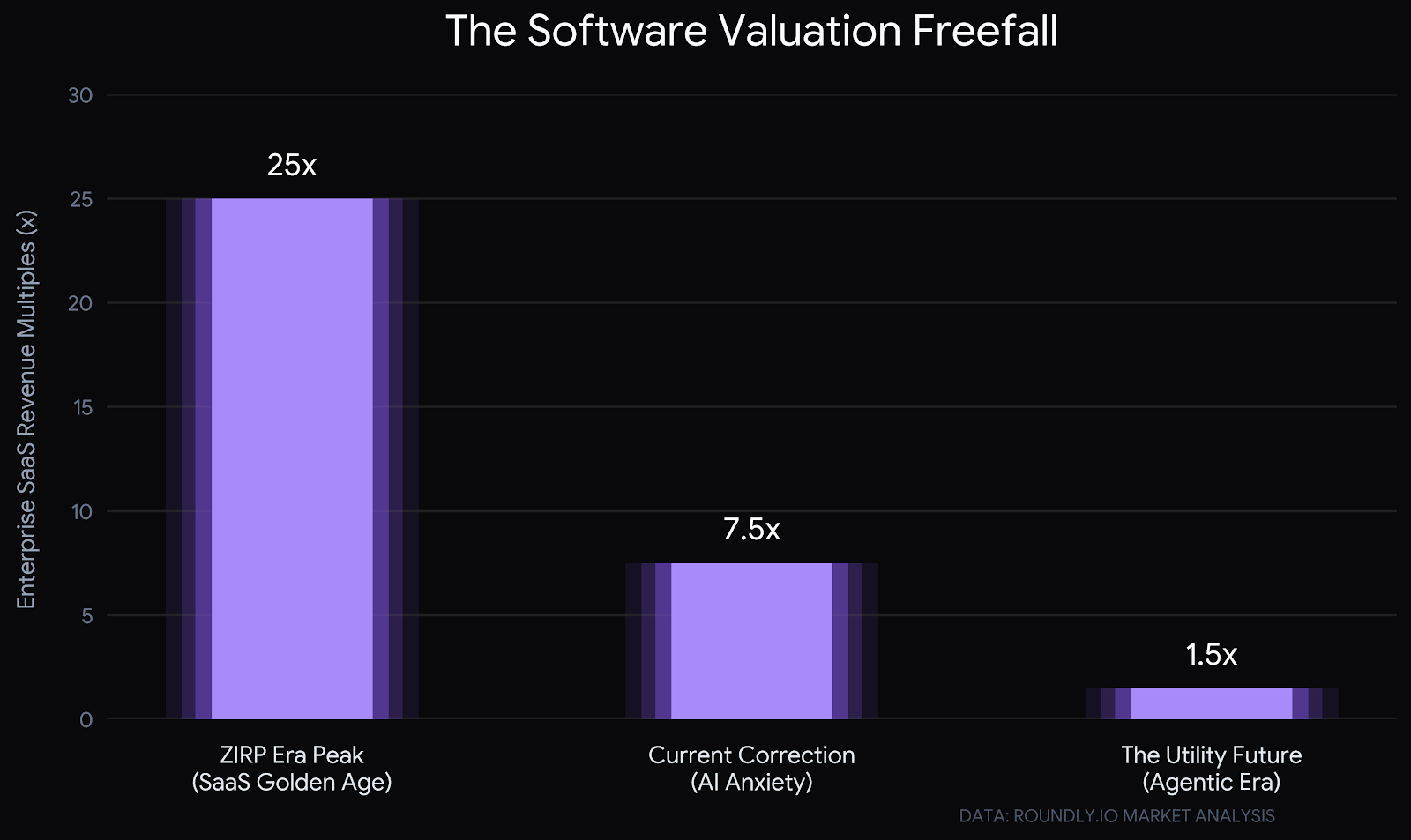
Public markets are already beginning to price in this reality, albeit slowly. The calculus of software valuations is undergoing a brutal correction:
The ZIRP Era Peak: Enterprise SaaS historically traded at 20x to 30x price-to-sales multiples, justified by high gross margins and near-zero churn rates.
The Current Correction: Many of these same companies have cratered to 5x to 10x multiples as growth slows and AI anxiety sets in.
The Utility Future: Normal, infrastructure-layer businesses—utilities—trade at 1x to 2x sales.
If software is no longer a high-margin toll bridge but rather an easily replicable commodity, there is no economic justification for 20x multiples. The market is waking up to the fact that enterprise software companies are no longer the apex predators of the tech ecosystem. They are highly vulnerable middlemen.
AI as the Ultimate Enterprise Compression Technology
To understand why the enterprise tech stack is about to shrink, you have to understand why it became so bloated in the first place.
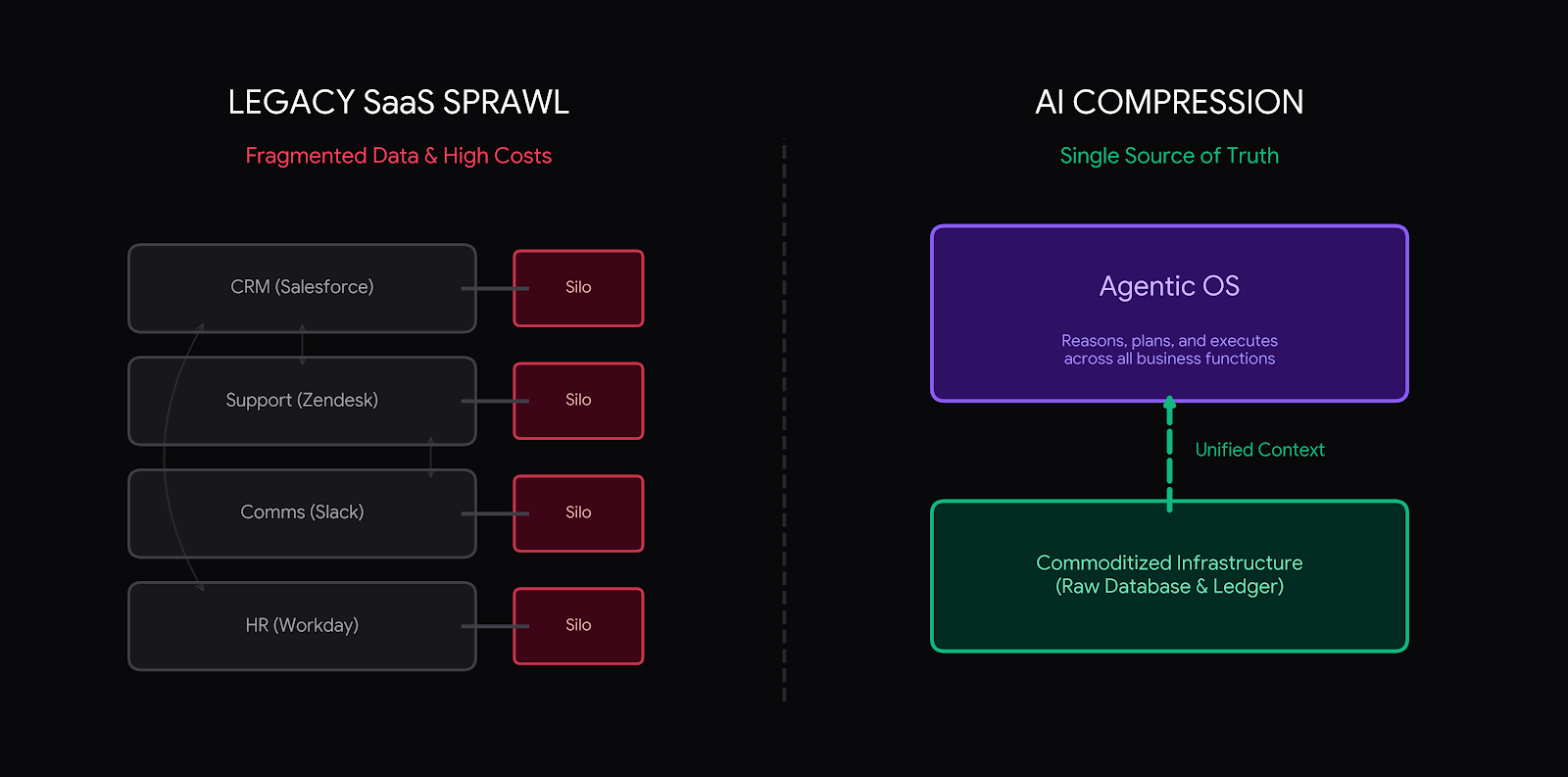
Modern companies duplicate data constantly. A single enterprise client, Sephora for example, exists as a record in Salesforce, a dedicated Slack channel, a Google Drive folder full of presentations, a billing record in Stripe, and a support history in Zendesk. The same fundamental information is stored, processed, and paid for across a dozen different vendor silos.
Siemiatkowski points to Wikipedia as the inverse of this model. Wikipedia is the most successful knowledge graph in the world because it aggressively enforces a single source of truth. There are not fifteen articles about Sephora on Wikipedia; there is one.
Large language models act as a profound compression technology. When you train a model on a company's internal data, it absorbs the duplicated records, the Salesforce entries, the Slack messages, the Google Docs, and compresses them into a unified understanding of the relationship. It ignores the redundancy and internalizes the signal.
The economic implications of this are staggering. Enterprise buyers fundamentally want the highest quality output at the lowest possible cost. They do not actually want to pay for fifty different software subscriptions to house the same data in slightly different formats. As AI models compress enterprise knowledge into centralized, highly contextualized operating systems, the justification for maintaining dozens of specialized, disjointed SaaS tools vanishes.
The "Company in a Box" Paradigm
The logical endpoint of this compression is the "Company in a Box." Imagine a small business environment entirely stripped of expensive, per-seat SaaS licenses.
Instead of paying a premium for modern software, a founder deploys a raw, open-source accounting ledger and an open-source database. On top of that raw infrastructure, they deploy an intelligent agent powered by a frontier model like Claude or GPT-4. The agent handles the interface. You simply tell the agent to reconcile the ledger, generate the invoice, or pull the customer’s purchase history.
The plumbing firm of the future isn't going to write its own code, but it also won't pay $150 a month per employee for a glossy software suite. It will buy an off-the-shelf AI agent that sits on top of free, commoditized infrastructure.
Building the Operating System, Not Buying the Silo
For large, technology-first organizations, the shift is even more aggressive. The traditional "build vs. buy" calculus has entirely flipped.
In the previous decade, the conventional wisdom dictated that a company should focus entirely on its core competency and buy SaaS for everything else. If you are a payments company, you don't build your own customer support software; you buy Zendesk.
Klarna is actively reversing this. They built their own AI customer service infrastructure, and the reasoning exposes a fundamental flaw in legacy SaaS. To provide truly exceptional, autonomous customer service, an AI agent needs absolute, unfiltered context. It needs to know exactly how a specific interest rate was calculated for a specific user. That information does not live in a generic customer support knowledge base. It lives deep within the source code of the company's proprietary financial engine.
When data is fragmented across external SaaS providers, providing an AI agent with the necessary context becomes a brittle, complex integration nightmare. To leverage AI effectively, a company's tech stack must be native to the AI. It requires collapsing the silos and creating a unified operating system where deterministic code and probabilistic AI share the exact same environment.
This is the hidden cost of the modern SaaS sprawl. It is not just the financial drain of licensing fees; it is the structural isolation of your own data, which starves your AI of the context it needs to actually be useful.
The Sharp Takeaway for Founders and Investors
The era of building a thin software wrapper, trapping user data, and calling it a moat is over. The venture capital community is currently pouring billions into AI startups without a clear understanding of the underlying mechanics of the technology. They are applying the SaaS playbook to an environment that actively destroys SaaS mechanics.
If you are an investor writing checks today, or a founder building a product, and you have not personally sat down with Cursor or Claude Code to build a functional prototype, you are flying blind. You lack the sensory input to judge how fast the water is draining from the pool.
The market has shifted from an environment that rewards lock-in to an environment that rewards compression and interoperability. The next wave of massive enterprise value will not be created by building another silo to store redundant data. It will be created by building agents that liberate that data, compress the bloated tech stacks of the Fortune 500, and return the enterprise to a single, unified source of truth.
The software money printing machine is broken. We are waking up to a reality where the product actually has to do the work.
( ' - ' )7
To filter through the noise view the complete feed of funding rounds at Roundly.io
Check out my other blog posts:
Nov 25
Generative Engine Optimization: Analyzing the Capital Flight from Search to Answers
Nov 19
Top 20 VCs Investing in AI in 2025 (The Active List)
Nov 17
Top 5 AI Investment Themes for 2026 (Backed by $216 Billion)